Microscopic Tribology: The Physics of EV Pad Vitrification (Glazing)
Traditional ICE braking regularly reaches 150°C–350°C, naturally burning off surface polymers and renewing the friction boundary layer. In EVs, one-pedal regenerative braking leaves foundation brakes under-utilized. Under persistent low-pressure (<10 bar) and low-temperature (<100°C) contact, uncured polymer binders and wear debris smear across the contact area, compacting into a smooth, glassy mirror surface that destroys frictional micro-roughness.
- Friction Coefficient Collapse: Glazed pads lose boundary shear adhesion, causing nominal μ to plummet from 0.40 to <0.25 during emergency stops.
- Morning Squeal Excitation: The glassy vitrified surface excites high-frequency resonances at the rotor interface under humid morning conditions.
Chemical Formulation: Active Micro-Abrasive EV Ceramic Matrices
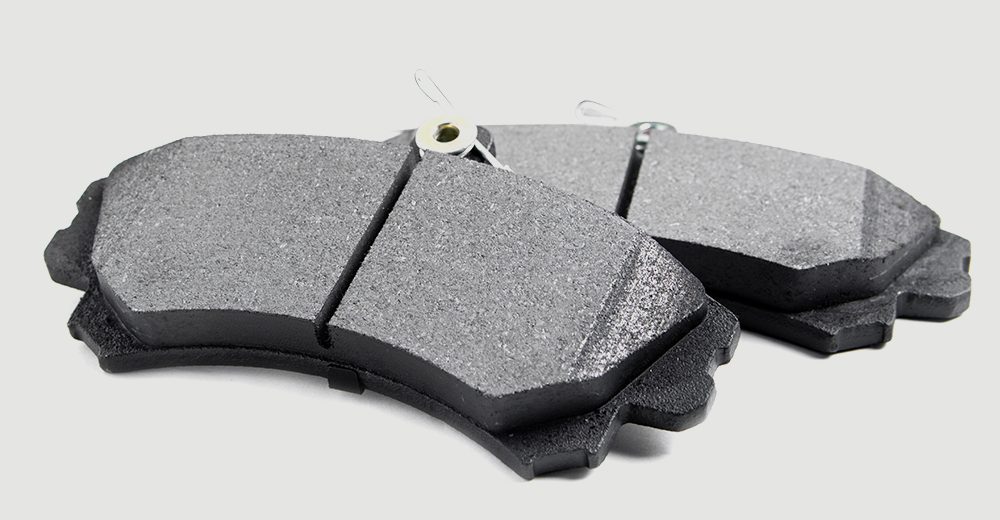
HENGBRAKE friction chemists solved EV vitrification by engineering an advanced ceramic matrix fortified with tailored sub-micron zirconia (ZrO2) and engineered mineral whiskers. These micro-scavengers continuously scour the cast iron rotor face under light pedal pressure, maintaining an active, non-glazed friction track while minimizing rotor thickness loss.
- High-Purity Synthetic Graphites: Delivers clean boundary lubrication without forming sticky, vitrifying polymeric residues.
- Flash Rust Scrubbing: Rapidly clears morning condensation rust within 2 wheel revolutions to prevent abrasive scoring.
Corrosion Shielding: Galvanized Backing Plates for Humid Wheel Wells
Because EV foundation brakes remain cool and rarely generate enough heat to boil away trapped moisture and winter road de-icing salts, traditional painted backing plates suffer severe rust jacking. HENGBRAKE EV pads feature fully galvanized steel backing plates with mechanical retention matrices, delivering >1,000 hours ASTM B117 salt spray protection and zero pad debonding.
- ASTM B117 >1,000h Rating: Galvanized zinc layer sacrifices electrochemically to protect the structural steel plate.
- Open Drainage Geometry: Precision chamfers and central gas channels eject trapped water, slush, and road grit.
| Performance Metric | Standard Passenger Car Ceramic Pad | HENGBRAKE Anti-Glaze EV Formulation | Sourcing & Fleet Advantage |
|---|
| Cold Friction Bite (μ_cold) | μ ≈ 0.32–0.35 (decays under regen use) | μ ≈ 0.39–0.42 (stable & immediate) | Instant stopping response during unexpected emergency braking |
| Resistance to Surface Glazing | Poor (vitrifies after 2,000 km city driving) | Exceptional (active micro-abrasive scouring) | Completely eliminates low-duty-cycle friction decay and grumble |
| Acoustic NVH in EV Cabins | Prone to low-frequency morning squeal (1.5–3 kHz) | Silent (vulcanized OE-grade RSR shims) | Meets strict luxury electric vehicle acoustic standards |
| Rotor Flash Rust Cleaning Speed | 10–15 full friction stops required | 1–2 initial wheel rotations | Prevents morning disc pitting and uneven disc thickness variation |
| Environmental Compliance | ECE R90 certified | ECE R90 + NSF LeafMark Level N (Copper-Free) | 100% compliant with global clean air and watershed regulations |
Technical Comparison: Standard Aftermarket Ceramic Pad vs. HENGBRAKE Anti-Glaze EV Formulation