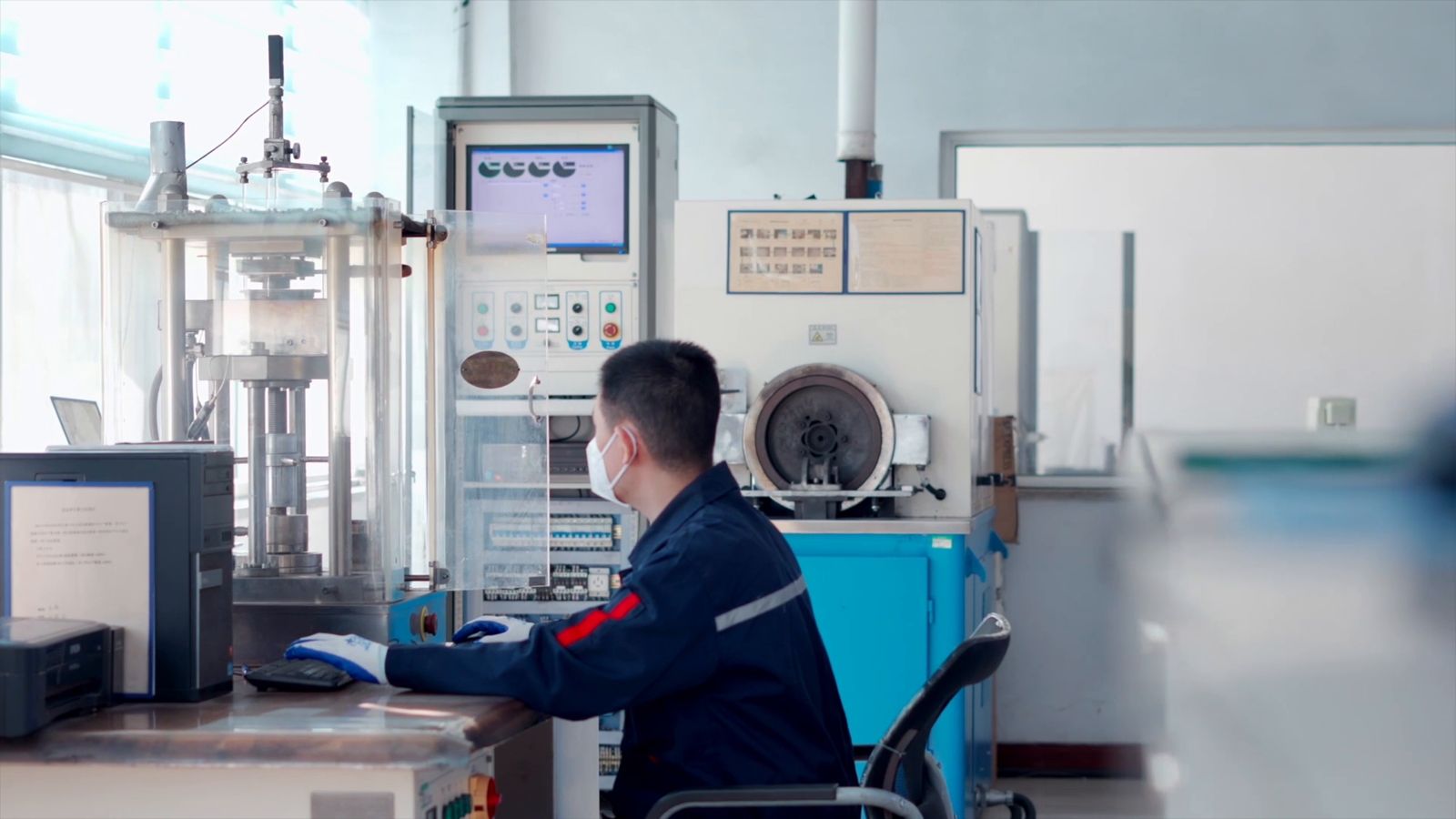
1. The ISO 6310 Laboratory Test Protocol
Standardized testing on universal compression benches measures microscopic thickness reduction under specific surface pressures up to 16 MPa (160 bar).
- Dual Temperature Regimes: Compares ambient elastic deformation (20°C) against elevated temperature thermal softening (400°C).
- Deflection Sensor Accuracy: Multi-point calibrated HBM displacement transducers record precise elastic vs. plastic strain curves across 4 continuous load cycles.
- Thermal Swell Assessment: Quantifies irreversible binder expansion and outgassing distortion under severe thermal load.
2. Hydraulic Fluid Displacement (ΔV) & Pedal Multiplication
Caliper piston area and brake pedal lever ratios amplify microscopic pad compression into substantial pedal travel at the driver's foot.
- Fluid Displacement Formula: ΔV = A_piston × Δd_pad × N_pads. Extra pad compression forces more hydraulic volume out of the master cylinder.
- Pedal Travel Multiplication: With standard pedal ratios (3.8:1 to 4.5:1), an extra 0.30mm of hot pad compression multiplies into nearly 24mm of additional pedal sinking.
- Driver Confidence Impact: Uncontrolled pad compression mimics the feel of boiling brake fluid or air in the lines, generating costly warranty returns.
3. Next-Gen Brake-by-Wire & ADAS T90 Pressurization
Integrated Power Brakes (One-Box EHB/EMB) require ultra-low pad compressibility to achieve fast pressure buildup for Autonomous Emergency Braking (AEB).
- T90 Target (<100ms): Brushless actuator motors must build 100 bar line pressure in under 100ms to satisfy ADAS safety targets.
- Compressibility Delay Penalty: Overly compliant pads force the motor pump to displace extra fluid volume, delaying full braking force by 50ms to 80ms.
- Stopping Distance Margin: An 80ms delay adds over 2.2 meters of vehicle stopping distance at 100 km/h.
4. Manufacturing Levers: How HENGBRAKE Controls Compressibility
Five proprietary manufacturing controls ensure strict ISO 6310 compliance without compromising acoustic NVH dampening.
- High-Tonnage Positive Compaction: Positive-mold pressing at >450 bar mold pressure achieves high bulk density (>2.65 g/cm³) free of internal voids.
- High-Crosslinking Modified Resins: Silicone-phenolic binders with high glass transition temperatures (Tg > 320°C) prevent high-temperature softening.
- Engineered Underlayer Modulus: Precision 1.2mm sub-layer provides acoustic NVH isolation without compromising hydraulic rigidity.
- 8-Hour Progressive Baking: Computer-controlled post-curing baking ensures 100% complete chemical polymerization.
| Vehicle Category / Platform | Ambient Comp. (20°C) | Hot Comp. (400°C) | Target Pedal Characteristic | Engineering Risk if Out of Spec |
|---|
| High-Performance Sports / Track | 0.8% – 1.2% | ≤ 1.5% | Ultra-stiff, razor-sharp bite | Excessive travel under high-speed threshold braking |
| Premium Passenger Car / SUV | 1.1% – 1.8% | ≤ 2.2% | Firm, linear, progressive modulation | Spongy pedal complaint and customer dissatisfaction |
| Electric Vehicle (Brake-by-Wire) | 1.0% – 1.5% | ≤ 1.8% | Instant pressure build for ADAS AEB | Delayed actuator T90 build; extended stopping distance |
| Heavy Commercial Vehicle (Truck/Bus) | 0.7% – 1.2% | ≤ 1.6% | Rigid pneumatic response, zero flex | Excessive air stroke consumption & taper wear |
| Substandard Budget Formulations | 2.5% – 3.8% | > 4.5% (Thermal Collapse) | Unpredictable, deep pedal sinking | Pedal bottoming out under severe mountain descents |
Table 11: ISO 6310 Compressibility Engineering Benchmarks, Deflection Thresholds and Vehicle Application Requirements.